
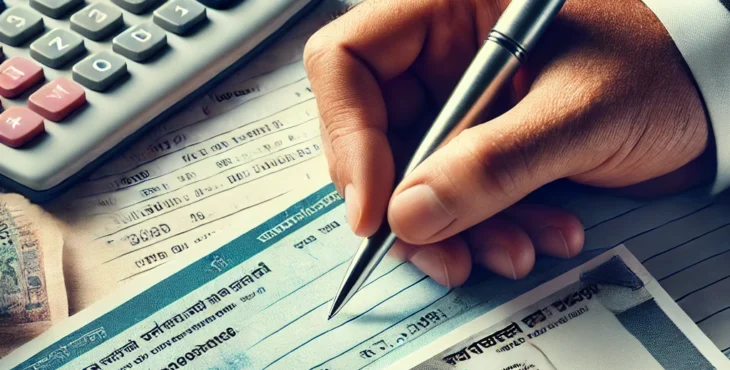
Cheques are widely used in India for various purposes, such as payments, money transfers, and business transactions. They serve as a secure way to transfer funds directly from one bank account to another. However, filling a cheque correctly is essential to ensure that the transaction goes through smoothly. Mistakes or incomplete details can lead to delays or even rejection of the cheque.
This article aims to guide you through the process of filling a cheque in India, ensuring that you understand each section and the details required to avoid common errors.
1. Introduction to a Cheque
A cheque is a written order directing a bank to pay a specific amount of money from the drawer’s account to the payee. It can be of two types:
- Bearer Cheque: The person holding the cheque can encash it without needing to prove their identity.
- Order Cheque: Only the person whose name is mentioned on the cheque can encash it.
Each cheque typically consists of the following parts:
- Cheque Number: A unique number that helps identify the cheque.
- Date: The date the cheque is issued.
- Payee Name: The name of the person or entity to whom the cheque is payable.
- Amount in Words: The amount written in words to prevent fraud.
- Amount in Figures: The amount is written numerically.
- Signature: The drawer’s signature authorizing the transaction.
- Bank Details: Information about the bank branch and account number.
Now, let’s break down each section of the cheque and guide you through filling it correctly.
2. Understanding the Key Sections of a Cheque
Before filling out a cheque, you need to understand the various sections and their functions:
- Cheque Number:
- Located at the top-right corner, this unique number helps identify the cheque in the bank’s system.
- The bank automatically prints it and doesn’t require any input from the drawer.
- Date:
- The date should be written in the format DD/MM/YYYY (day, month, year).
- It’s important to remember that the cheque is valid only for three months from the date issued. After that, it becomes stale-dated and cannot be cashed.
- Payee Name:
- This is the person or entity to whom the cheque is being issued.
- You need to write the full name or the name of the company exactly as it appears in official records.
- In case of a bearer cheque, you can write “Bearer.” However, for an order cheque, the name of the payee must be written clearly.
- Amount in Words:
- This section is crucial as it helps prevent fraud.
- Write the amount in words, followed by the word “only” to indicate the final amount. For example: “Five Thousand Rupees Only.”
- Ensure that you write the amount clearly and without leaving any space for alterations.
- Amount in Figures:
- This section is where you write the amount numerically, for example, ₹5000 or ₹2500.
- Be sure that the figure matches the amount written in words.
- If the written amount and the numeric amount do not match, the bank may reject the cheque.
- Signature:
- The drawer must sign the cheque exactly as it appears in the bank’s records.
- The signature authorizes the bank to make the payment.
- Bank Branch Details:
- This includes the name of the bank, the branch, and the bank’s MICR code (Magnetic Ink Character Recognition), which helps in the electronic processing of the cheque.
3. Step-by-Step Guide to Fill a Cheque
Let’s walk through the process of filling out a cheque step-by-step.
Step 1: Write the Date
- Start by writing the current date in the date field on the top-right corner of the cheque.
- The format for the date in India is DD/MM/YYYY. For example, if today is March 20, 2025, you would write: 20/03/2025.
Step 2: Write the Payee Name
- In the “Pay” or “Payee” field, write the name of the person or company you are paying.
- Be careful to avoid abbreviations and use the full name to avoid confusion. For example, write “John Doe” instead of just “John.”
- If you are writing a bearer cheque, you can write “Bearer,” meaning the cheque can be encashed by whoever holds it.
Step 3: Write the Amount in Words
- Write the amount of money you are paying in words, ensuring it matches the numeric value you will enter later.
- The amount should be written in full and include the word “only” to prevent alterations. For example, if you are writing a cheque for ₹5,000, you would write: “Five Thousand Rupees Only.”
Step 4: Write the Amount in Figures
- In the box next to the payee’s name, write the amount numerically.
- Ensure that the written figures match the amount you’ve written in words. For example, ₹5,000 in figures must match the “Five Thousand Rupees Only” written in words.
- Avoid leaving spaces between numbers. For example, don’t leave a gap between ₹5 and 000; write ₹5000.
Step 5: Write the Bank Name
- In the field where your bank’s name is mentioned (often printed on the top left), ensure it is visible and correct.
Step 6: Sign the Cheque
- Sign the cheque at the bottom-right corner. The signature must match the one on file with your bank.
- Never sign a blank cheque, as this could be misused.
Step 7: Add the Account Number and Branch Details (Optional)
- In case the account number is not pre-printed on the cheque, you can manually add it in the appropriate section.
- Always check the branch name and ensure it matches your account’s branch to avoid any discrepancies.
4. Common Mistakes to Avoid When Filling a Cheque
Filling a cheque correctly is essential to ensure it’s processed smoothly. Here are some common mistakes to avoid:
- Mismatch Between Amount in Words and Figures: Always double-check to make sure that both the written and numeric amounts match.
- Leaving Blank Spaces: Don’t leave any space in the “Payee” or Amount sections. If there’s a need to correct something, draw a line through it and write the correction clearly.
- Incorrect Signature: Ensure that your signature matches the one on file with the bank.
- Post-Dated or Stale-Dated Cheque: A cheque is valid for only three months from the date of issue. Don’t issue a cheque with a future date (post-dated cheque) or one that’s older than three months (stale-dated).
- Crossing the Cheque: If you intend to issue a crossed cheque (which can only be deposited into a bank account), make sure to draw two parallel lines across the cheque and write “A/C Payee” between them.
5. Conclusion
Filling a cheque in India requires careful attention to detail. A correctly filled cheque ensures that the transaction proceeds smoothly without any issues. By following the steps outlined above and avoiding common mistakes, you can ensure that your cheques are filled out accurately and securely.
Remember, cheques are a form of financial responsibility, and proper handling is essential to maintaining trust in your financial transactions. By understanding the process and taking the time to fill out your cheques correctly, you’ll be able to ensure that your transactions are both valid and secure.